
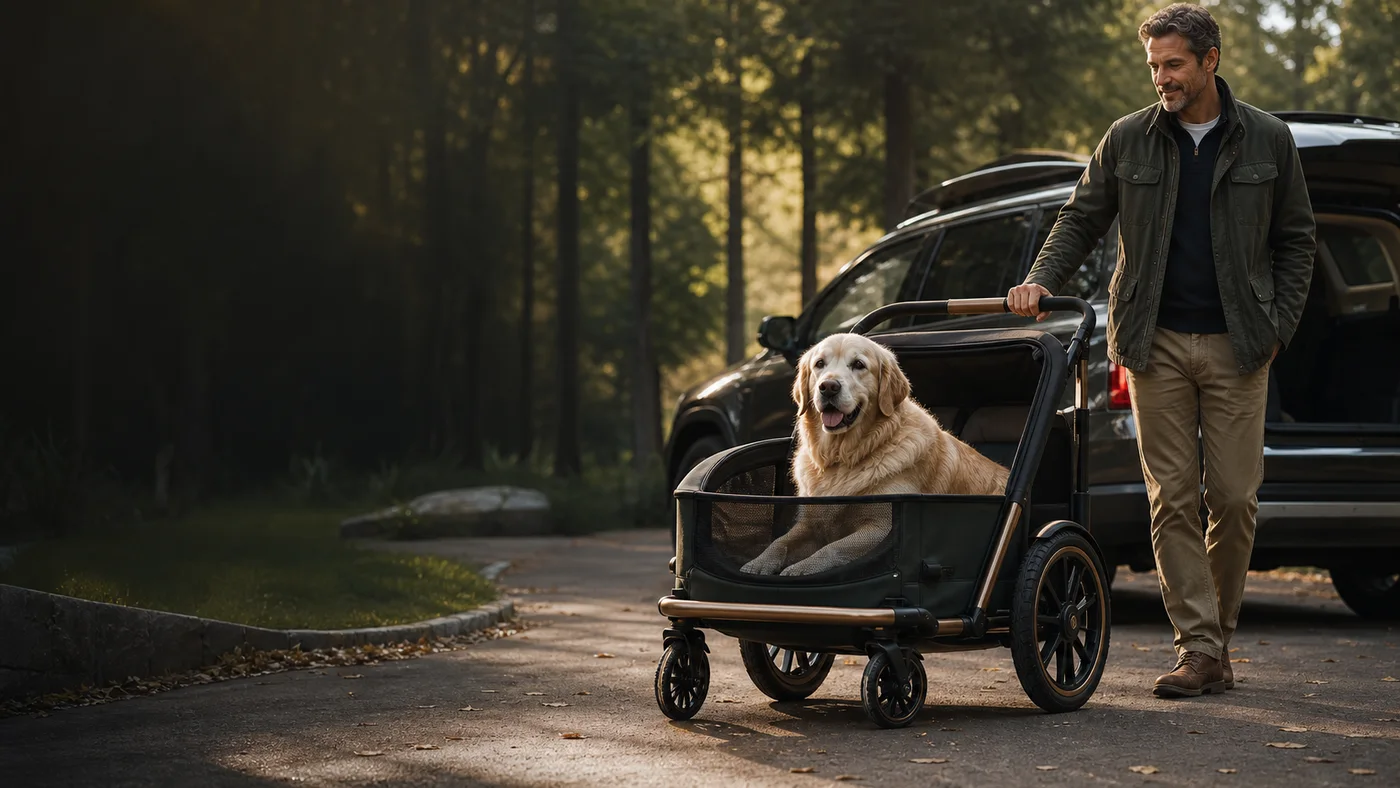
Searching for a dog wagon for large senior dogs usually begins with a familiar problem: the dog still wants to come along, but the full walk, park loop, or family day has become harder to finish. The right carrier should not turn that change into a complicated project. It should give the dog a comfortable place to rest and give the person pushing it enough control to use it in ordinary life.
Before comparing colors or marketing labels, look at the entire routine from the front door to the return home. A product that feels spacious in a photo can still be awkward to enter, difficult to steer with a large dog inside, or too bulky for the vehicle. These seven checks help separate a practical mobility option from a purchase that may stay in storage.
This guide is about everyday equipment selection, not diagnosis or treatment. Ask your veterinarian about pain, injury, recovery, or changes in mobility.
Start with the routine, not the product name
“Dog wagon,” “large dog stroller,” and “dog cart” are often used loosely online. The label matters less than the job the product must do. Picture the dog leaving home, entering the carrier, moving over the usual surface, resting during the outing, returning to the car, and being stored afterward.
If you are still deciding between product types, read our large dog stroller vs dog wagon comparison first. Then use the checks below on the specific model you are considering.
1. Can the dog enter without a stressful lift?
Entry is often the first real-life test. Measure the height of the opening and look at how the side, front, or rear panel moves. Then compare that setup with what the dog can comfortably do today. A dog that hesitates at a high edge may need a different entry plan than a dog that can still step onto a low, stable surface.
Also consider the person handling the dog. If the routine depends on lifting a heavy dog into the cabin every time, decide honestly whether that is safe and repeatable. Do not assume a low-looking product includes a ramp or step. Confirm exactly what is supplied and what the manufacturer approves for entry.
2. Is there room for the dog’s real resting posture?
Weight capacity alone does not tell you whether a large dog will fit. Two dogs at the same weight can have very different body length, shoulder height, chest width, and resting posture. Measure the dog while relaxed, not while stretching forward for a treat.
- Measure body length from the front of the chest to the base of the tail.
- Measure shoulder height from the floor to the top of the shoulder blades.
- Measure body width at the widest relaxed point.
- Notice whether the dog normally curls, sits upright, or lies with the front legs extended.
Compare those measurements with the usable interior dimensions, not the outside frame. Our large dog stroller Fit Guide explains what to measure before you buy.
3. Can the frame stay controlled with real weight inside?
A dog wagon may feel easy to move when it is empty. The meaningful test is how the frame behaves with the dog’s weight inside and the owner’s hands on the handle. Look for a stable stance, predictable steering, and brakes that are easy to reach and engage.
Think about where you pause during a normal outing: a driveway, a park entrance, a curb cut, or a slightly sloped path. Brakes are for controlled stops, but they do not make an unsafe slope appropriate. The handler should always be able to keep the product close and steady without relying on the dog to balance it.
4. Do the wheels match the routes you actually use?
“All-terrain” is not a useful promise unless the seller explains what surfaces the wheels are intended to handle. Smooth pavement, packed gravel, lawn edges, broken sidewalks, deep sand, and muddy paths create very different demands.
For regular park paths and firm gravel, look at wheel diameter, tread, steering control, and the way the frame absorbs small bumps. Deep sand, stairs, and steep trails may still be unsuitable even for a rugged-looking product. If gravel is part of your routine, review our guide to using a large dog stroller on gravel roads.
5. Will it fit the SUV and the place where you store it?
A product can fit the dog and still fail the family routine if it cannot pass through the cargo opening or if one person cannot load it. Measure the SUV’s cargo-opening width and height, the usable floor depth, and any loading lip. Then compare those numbers with the product’s published folded dimensions.
Do not stop at “it folds.” Ask what must be removed before folding, how much the folded unit weighs, whether it stands securely, and where loose accessories will go. The SUV trunk fit guide for large dog strollers gives a simple measurement checklist.
6. Can the dog settle without feeling shut away?
A large senior dog may spend more time resting than riding upright. Look for airflow, visibility, a stable floor, and enough room to change position. Mesh panels should let the owner check the dog without requiring the cabin to be opened during movement.
Follow the manufacturer’s instructions for any tether or restraint point, and attach only as directed. A familiar washable mat can help the cabin feel predictable, but it should not block ventilation or interfere with closing panels.
7. Can the family repeat the routine next week?
The best big dog stroller or senior dog wagon is the one the family can use again without dreading the setup. Before checkout, picture cleaning wet wheels, drying the cabin, folding the frame, lifting it into the vehicle, and storing it between outings.
Check which parts are removable, how replacement parts and support are handled, and whether the person who will use it most can operate every latch and brake. A product earns its place when the entire routine feels manageable, not only when the dog looks comfortable in the first photo.
Dog wagon, large dog stroller, or utility cart?
A purpose-built dog wagon may offer generous resting room, while a large dog stroller often emphasizes controlled pushing, an enclosed cabin, and predictable movement. A utility cart is designed primarily for gear and may not provide the ventilation, enclosure, floor support, or restraint guidance expected for a dog.
Do not convert a general cargo cart simply because the dog fits inside. Choose equipment designed and documented for carrying pets, then verify the real measurements and operating instructions.
A quick decision before checkout
You should be able to answer each of these questions before placing an order:
- Do I have the dog’s current body length, shoulder height, width, and weight?
- How will the dog enter and exit every time?
- Which surface will we use most often?
- Can the main handler control, brake, fold, and lift the product?
- Will the folded frame fit through the cargo opening and storage area?
- Have I read the current return, support, and replacement-parts information?
- If mobility has changed, have I discussed the underlying concern with a veterinarian?
Where Atlas fits in this decision
Steadavo Atlas is our large-dog mobility system for families comparing controlled outdoor movement with a supported place to rest. It is not a medical device, and breed name alone does not guarantee fit. Review the current published dimensions, entry note, product photos, and handling details on the Steadavo Atlas product page. If any measurement is close to the limit, use the Fit Guide or contact support before ordering.
Frequently asked questions
Is a dog wagon good for a large senior dog?
It can be useful when the dog still enjoys family outings but needs a place to rest. The right choice depends on current measurements, entry needs, the route, and the handler’s ability to control and store the product.
What size dog wagon should I choose?
Use the dog’s relaxed body length, shoulder height, width, and weight. Compare those numbers with the usable interior dimensions and leave enough room for the dog’s normal resting posture.
Is weight capacity enough to confirm fit?
No. Weight capacity is only one limit. Cabin length, width, height, opening size, floor support, and the dog’s preferred posture also matter.
Can I use a large dog wagon on gravel and carry it in an SUV?
Possibly, but confirm both jobs separately. Check the wheel design and handling guidance for firm gravel, then compare the folded product dimensions and weight with the SUV cargo opening and the person who will load it.