

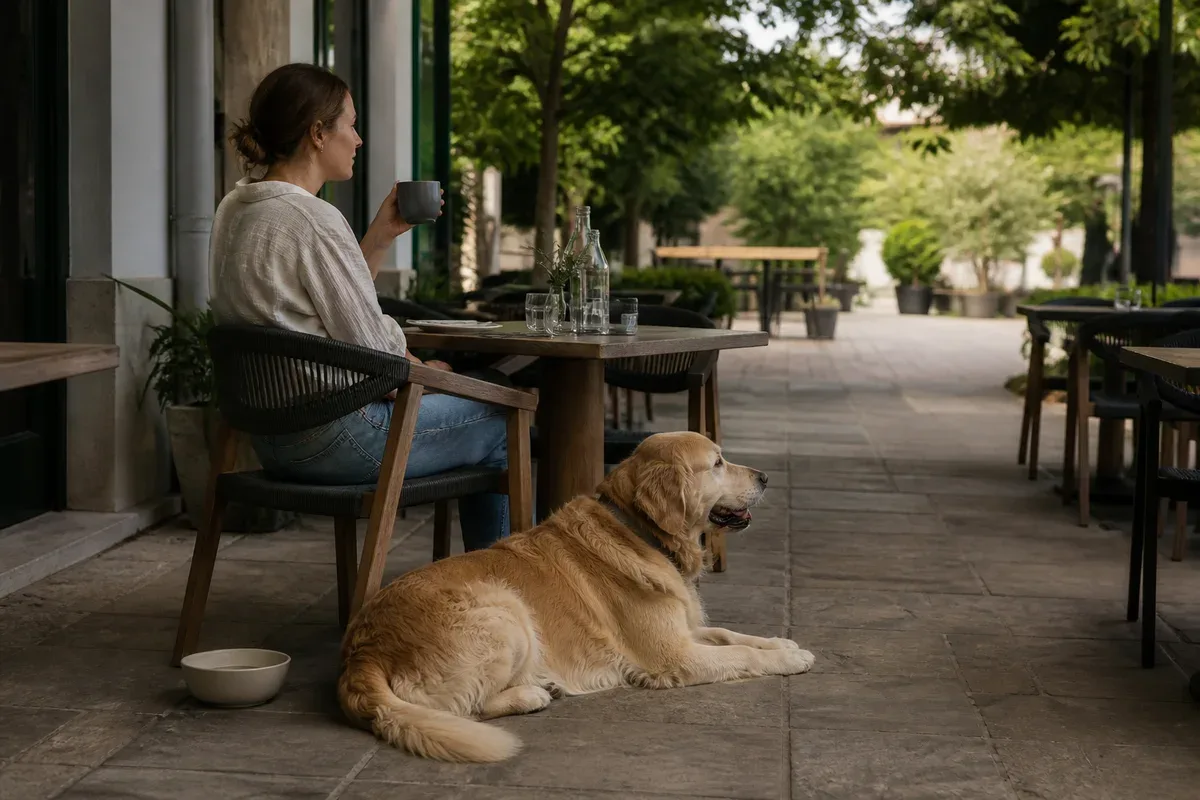
Dog-friendly patio etiquette begins before anyone takes a seat. A patio can be a pleasant way to include a large or older dog in an ordinary family routine, but “dogs allowed” does not automatically mean the space will be comfortable for this dog on this day. Shade, table spacing, foot traffic, noise, weather, and the dog’s ability to settle all matter. The useful goal is not to prove that a dog can stay through a full meal. It is to create a short, calm visit that works for the dog, the restaurant, and the people sharing the space.
This guide covers practical planning for pet dogs at outdoor dining areas in the United States. Restaurant policies and state or local rules vary, and a business may set conditions for pets on its patio. Service animals have different legal access rights under the Americans with Disabilities Act, so pet-friendly patio guidance should never be used to question or police another person’s service animal.
Plan dog-friendly patio etiquette before leaving home
Call or check the restaurant’s current policy rather than relying on an old directory listing. Ask whether pet dogs are allowed in the outdoor dining area, whether reservations are useful, and whether the patio has a quieter edge table. The 2022 FDA Food Code added an exception that allows pet dogs in outdoor dining areas where approved, but the Food Code is a model used by jurisdictions, not a universal promise that every patio accepts pets. Current local rules and the restaurant’s own policy still govern the visit.
Then assess the dog in front of you. A dog who is already panting hard, sore after a long walk, unusually restless, or worried by crowds may be happier at home. Choose a mild time of day and keep the first outing brief. If mobility equipment is part of the routine, use the Steadavo Fit Guide to organize current measurements and handling questions before arriving in a tight public space.
Pack a small, quiet kit: a short fixed-length leash, waste bags, water, a collapsible bowl, a simple rest mat if the dog already knows it, and any routine medication your veterinarian has prescribed. Skip squeaky toys, long chews that encourage guarding, and a retractable leash that can cross a walkway. The kit should make settling simpler, not turn the table into a campsite.
Choose a table that supports dog-friendly patio etiquette
Table choice is one of the strongest controls available. Look for shade, stable footing, space beneath or immediately beside the table, and a route that does not force the dog through a cluster of chairs. A perimeter table is often easier than the center of a busy patio. Avoid the server station, entrance gate, restroom route, and the narrow turn where staff carry trays.
A large dog needs enough floor area to lie down without extending into an aisle. Before sitting, picture the dog at full resting length and leave a clean path for guests, wheelchairs, strollers, and staff. Do not tie the leash to a lightweight chair or table that could move if the dog stands suddenly. Keep the leash in an attentive adult’s hand or use only a secure arrangement explicitly permitted by the restaurant and appropriate for that dog.
Check the ground as well as the layout. Dark pavement can be hotter than the air, metal grates may catch paws, and spilled food or broken glass can hide under a table. If the surface or space is wrong, ask for another table or make a graceful exit. Good dog-friendly patio etiquette treats a change of plan as normal, not as a failed outing.
Use dog-friendly patio etiquette for a quiet arrival
Give the dog a short bathroom and sniff break before entering. Approach the patio at walking pace, keep the leash short enough to prevent greetings across tables, and pause outside if the entrance is crowded. One adult can check in while the other waits with the dog. That small division of work prevents a large dog from standing in a doorway while staff rearrange a table.
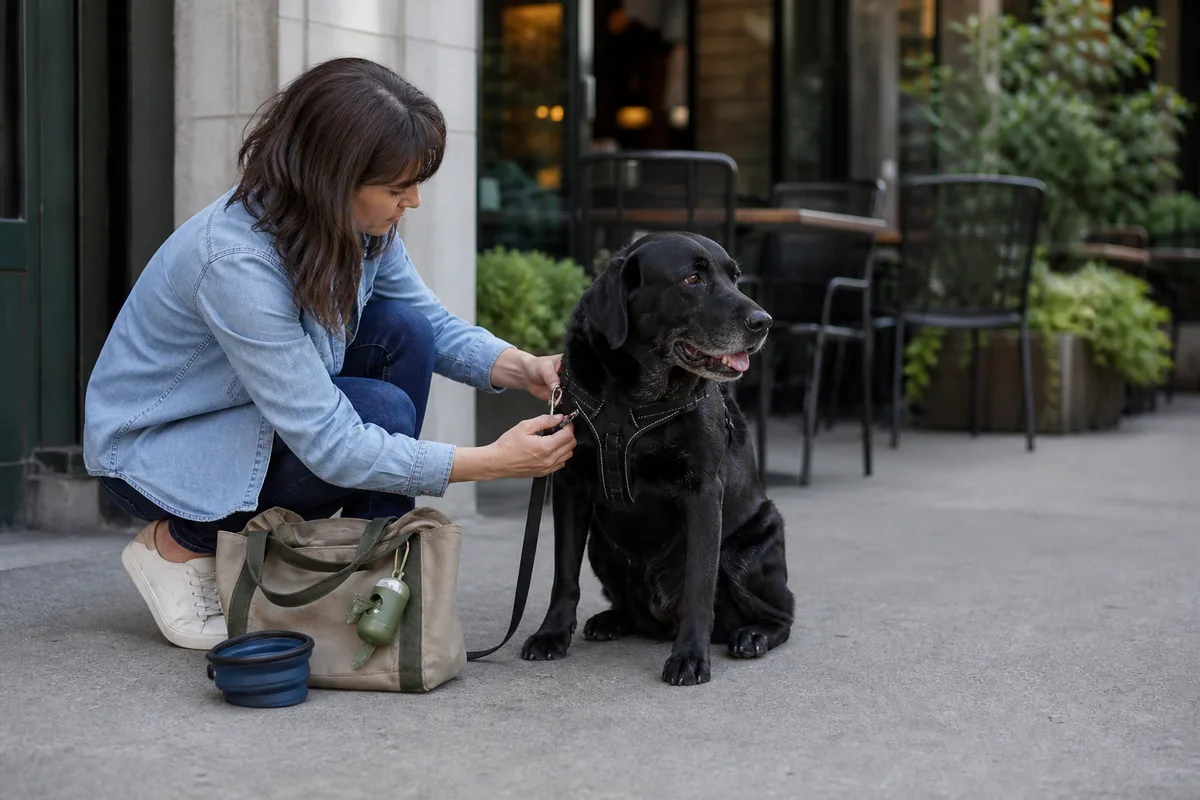
Guide the dog directly to the planned resting spot and reward calm behavior in the familiar way used at home. Place the water bowl where it cannot be kicked into the aisle. If a mat is part of the routine, keep it fully within the table area. Do not allow the dog to wander from chair to chair or investigate neighboring meals. A calm arrival gives the dog a clear job: settle close, observe, and rest.
Use dog-friendly patio etiquette around food and water
The table is for people’s meals. Even when a patio welcomes pet dogs, feeding from plates or allowing a dog onto a chair creates sanitation and space problems. The U.S. Department of Justice service-animal FAQ notes that restaurants are not required to allow service animals to sit on chairs or be fed at the table; for pet dogs, the restaurant’s patio policy may be more restrictive. Bring the dog’s water in a separate bowl and follow staff directions about where it may be placed.
Do not let the dog lick tableware, nose a server’s tray, or clean dropped food from beneath neighboring tables. Common restaurant foods can also contain ingredients that are unsuitable for dogs. If food falls near the dog, block access calmly and ask staff how they would like it handled. A practiced “leave it” cue helps, but management and distance are more reliable than expecting perfect obedience in a stimulating setting.
Hand hygiene matters after touching a dog, handling a bowl, or cleaning waste. The CDC’s hygiene guidance around animals recommends washing hands with soap and water after contact with pets, pet equipment, food, or waste and before eating or drinking. When soap and running water are not immediately available, the CDC advises using hand sanitizer with at least 60 percent alcohol until proper handwashing is possible. Keep the advice practical: clean hands before returning to the meal, and never place a used dog bowl on the dining table.
Share the patio without forcing greetings
Other guests may love dogs, fear them, have allergies, use mobility devices, or simply want space. Do not let the dog approach another table without an explicit invitation from both handlers involved. A friendly dog can still startle someone when its head appears beside a chair. Keep the dog close, decline greetings when the aisle is narrow, and move your own chair rather than asking strangers to squeeze past.
Give working service animals particular space. Under the ADA, service animals generally accompany their handlers in restaurants even when pets are not allowed, and they are expected to remain under handler control. A pet dog should not be allowed to stare, bark at, approach, or distract a service animal. Do not ask the handler personal questions or challenge the animal’s status. The calmest response is simply to maintain distance and continue your own routine.
If another pet dog arrives, avoid on-leash introductions between tables. Increase distance before either dog becomes fixed on the other. Ask for the check, change seats, or take a short reset outside if needed. Dog-friendly patio etiquette is easier when handlers act on early tension rather than waiting for barking, lunging, or tangled leashes.
Read comfort and leave before the visit unravels
A dog does not need to bark to say that the setting is too much. Repeated standing, scanning, panting unrelated to temperature, tucked posture, trembling, refusal of familiar cues, persistent attempts to leave, or inability to settle can all justify ending the visit. These signs are contextual and not a diagnosis. Sudden behavior or mobility changes mean the family should speak with the dog’s veterinarian.
Make departure simple. Settle the bill before packing the dog’s items, check under the table for waste and gear, and choose the clearest exit route. One adult can leave with the dog while another finishes the table if the gate is busy. Clean any spill or accident promptly and alert staff instead of trying to hide it.
A ten-minute drink that ends calmly can be a better first patio experience than a long meal that pushes past the dog’s limit. Record what worked: time of day, table location, duration, distance from foot traffic, and the dog’s settling pattern. That information turns the next outing into a thoughtful adjustment rather than another test.
Build a repeatable shared-space routine
The strongest dog-friendly patio etiquette is uneventful. The dog rests on the ground, the aisle stays usable, staff can work, and the handler notices small changes early. Repeat the same arrival cue, resting location, water routine, and exit plan. Familiar structure can make a public setting easier without requiring the dog to enjoy every patio.
For more calm ownership and outing ideas, browse Pet Lifestyle Field Notes. Keep the standard modest: choose a suitable place, protect shared space, and finish while everyone is still comfortable. Inclusion works best when it remains considerate and optional.
Sources and further reading
- U.S. Food and Drug Administration: Summary of Changes in the 2022 FDA Food Code
- U.S. Department of Justice: Service Animals
- Centers for Disease Control and Prevention: Hygiene Practices Around Animals
Frequently asked questions
Should I call before bringing my dog to a restaurant patio?
Yes. Pet policies and local approvals vary, so confirm the restaurant’s current outdoor-dining rules, table options, and any conditions before leaving home.
Where should a large dog rest at a patio table?
Choose a shaded perimeter table with stable footing and enough room for the dog to lie fully beneath or beside the table without extending into an aisle.
How long should a first patio visit last?
Keep it shorter than you think necessary. A brief drink or snack that ends while the dog is settled creates a clearer baseline than a full meal that pushes past comfort.
Are pet dogs and service animals covered by the same restaurant rules?
No. Service animals have access rights under the ADA that differ from pet policies. Do not use pet-patio rules to question or interfere with another person’s service animal.