

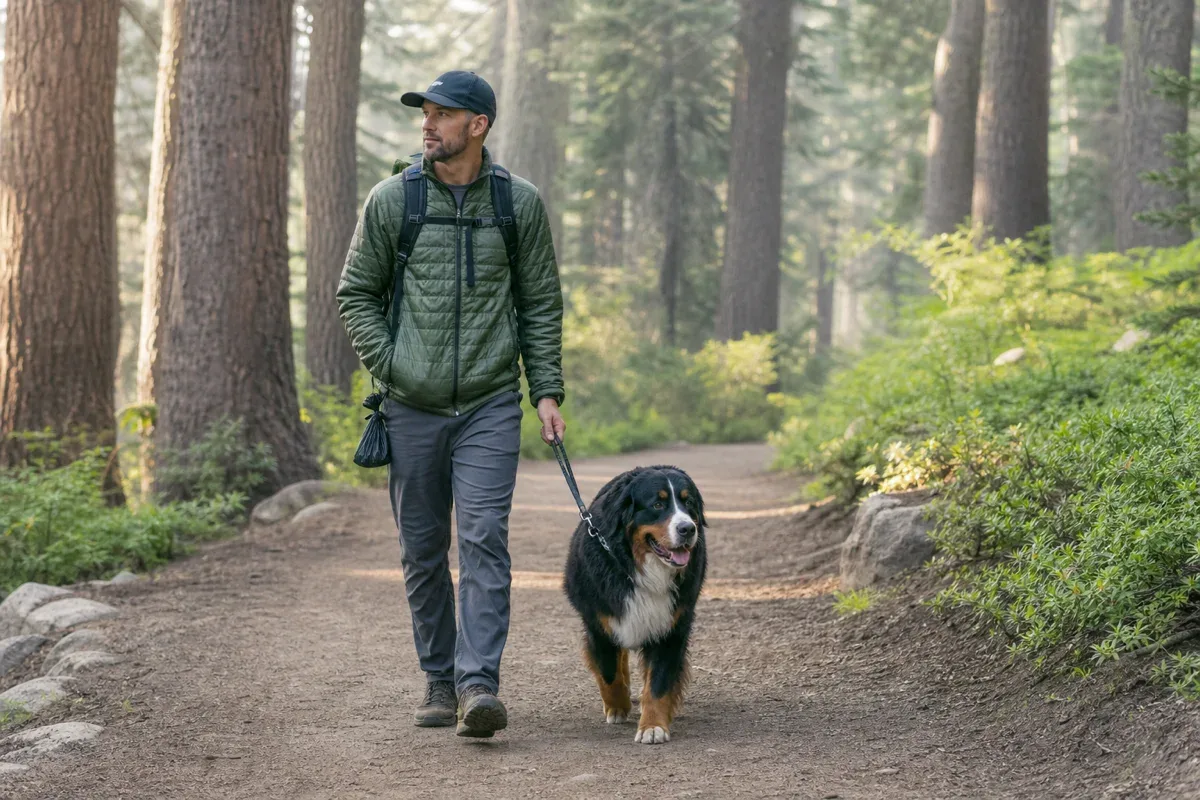
Leave No Trace with dogs is a trail routine, not a slogan. It begins before the car door opens: confirm that dogs are allowed, read the current leash and seasonal rules, pack water and waste bags, and choose an outing the dog can complete without forcing the trail to absorb the consequences. On the route, the work is equally practical—keep the dog controlled, stay on durable surfaces, carry waste out, give wildlife distance, and make room for other visitors.
The exact rule depends on the place. National parks, Bureau of Land Management trails, state lands, tribal lands, local preserves, and private destinations can set different access, leash, waste, and closure requirements. Leave No Trace principles guide low-impact behavior; they do not replace the land manager’s current rules.
Leave No Trace with dogs begins before the trail
Start on the official page for the exact destination. Check whether pets are permitted on the route, not merely at the campground or parking area. Read current alerts, wildlife or nesting closures, leash requirements, waste instructions, weather, and trail conditions. The National Park Service notes that many national parks do not allow pets on hiking trails or boardwalks, while the Bureau of Land Management says dogs are welcome on most of its trails but local leash rules vary.
That difference is why one universal answer is unreliable. A six-foot leash is sensible general NPS hiking guidance, but it is not proof that every public trail uses the same legal standard. If the official page is unclear, contact the field office, ranger station, or managing organization before departure. The goal is not to search for the loosest interpretation; it is to arrive knowing how to use that place responsibly.
Match the route to the dog as well as the rule. Surface, distance, elevation, shade, water access, crowding, and the return route all matter. A large senior dog may be comfortable on a broad short path and overwhelmed on a narrow busy trail. Leave a turnaround margin instead of treating the published distance as a target.
Pack a small kit that prevents avoidable impact
A useful dog trail kit is uncomplicated: a standard leash in good condition, a well-fitted collar or harness, more waste bags than the expected number of stops, water for the dog, a bowl, identification, and the items required by the individual dog. Add a second way to secure the dog in case hardware fails. Do not assume the trailhead has water, bags, or a trash bin.
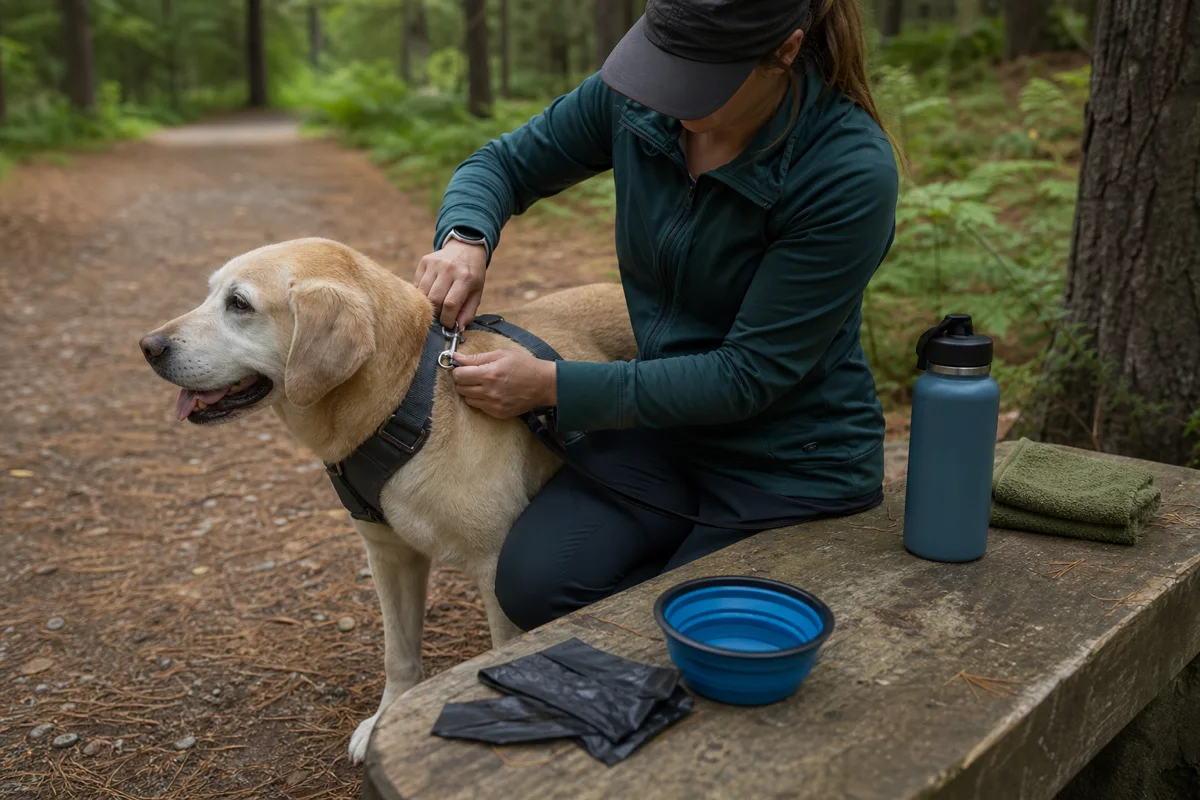
Pack for the return as carefully as the outward walk. A tied waste bag still has to travel somewhere without leaking or being left beside the path. Use a durable container or the outside of a pack, and carry it to an authorized receptacle or back home. A towel can help with wet paws before the car. Food, if needed, should be secured so wildlife cannot reach it.
Leave No Trace with dogs on durable routes
Control protects more than one dog. Leave No Trace advises using a leash where required and preventing pets from wandering beyond designated routes or off-leash areas. NPS and BLM guidance also emphasizes keeping dogs away from wildlife and staying on established paths. Even a friendly dog can flush birds, stress mammals, disturb vegetation, or surprise a visitor who does not want contact.
Walk near the center of the durable tread when it is safe to do so. Avoid widening the trail to bypass mud, plants, or another group. If conditions make the route unsuitable, turn around rather than creating a new track. At a narrow section, pause at a durable spot and keep the leash short enough to prevent the dog from entering vegetation while others pass.
Control is not the same as constant tension. Give the dog enough room for a natural stride while keeping the line out of other people’s path. Retractable leashes can be difficult to manage around corners, bicycles, horses, and wildlife; choose equipment that gives the handler clear, immediate control for the setting.
Pack out dog waste every time
Dog waste is not a natural addition to a recreation area. Leave No Trace directs visitors to bag it and place it in the trash, helping protect water, plants, habitat, and the experience of other visitors. The dependable routine is simple: notice the stop, bag the waste, tie the bag, carry it, and use an authorized receptacle or take it home.
Do not leave a bag beside the trail for later. Even with good intentions, bags are forgotten, moved by weather, or encountered by wildlife and other visitors. Do not assume burying dog waste is allowed. Disposal instructions can differ by land manager, so follow the current site rule. Pack extra bags for damage, an unexpected second stop, or another visitor who runs out.
Waste handling is one of the clearest ways to practice Leave No Trace with dogs because the action has a visible beginning and end. Nothing remains on the trail, and no one else has to solve it.
Leave No Trace with dogs by giving wildlife distance
Wildlife does not need to make contact with a dog to be affected. A chase, fixed stare, bark, or approach can interrupt feeding, nesting, resting, or movement. Keep the dog close, never encourage pursuit, and move away before interest becomes an encounter. Do not feed wild animals or allow the dog to investigate dens, nests, carcasses, or droppings.
Use terrain and timing to create space. Step onto a durable pullout, turn around, or wait for an animal to move away according to local guidance. If the dog is highly reactive to wildlife, the responsible choice may be a different route or staying home. An outing that repeatedly pushes the dog over threshold is not improved by completing the mileage.
Food and treats also matter. Keep them secured, retrieve anything dropped, and never leave scraps. A clean rest stop protects the dog from questionable food and prevents animals from associating people and pets with a reward.
Yield early and make encounters calm
Courtesy reduces both social friction and physical impact. BLM tells hikers with dogs to yield to all other trail users, and Leave No Trace encourages asking before allowing a dog to approach. Move to a durable side area where one exists, keep the dog close, and let the other party decide whether contact is welcome. A cheerful “we’ll wait here” is often enough.
Pay special attention around horses, bicycles, children, and other dogs. Follow posted yielding rules and the direction of riders or handlers. Do not stretch a leash across the trail. Limit barking, and increase distance rather than insisting on a greeting. If the route is too crowded for the dog to settle, use the turnaround plan.
Families planning a supported route can review Using a Large Dog Stroller on Gravel Roads for surface questions. Mobility equipment can support rest where it is permitted and practical, but it does not change pet-access rules or make a narrow trail suitable for a large setup.
Adapt the outing for a large or senior dog
Low-impact travel includes respecting the dog’s present limit. Choose a route with a clear return, stable footing, and planned pauses on durable ground. Offer water; do not rely on streams or lakes. Watch pace, coordination, breathing, willingness to continue, and the amount of recovery needed after a stop. Finish while the dog can still move calmly back to the vehicle.
The Steadavo Fit Guide can help a family organize current measurements and handling questions before using mobility support. It does not determine trail access, diagnose a health problem, or replace veterinary advice. Speak with a veterinarian about fitness, vaccinations, parasite prevention, or health-specific planning when those questions apply to your dog and destination.
A shorter route is not a lesser outdoor experience. It can reduce unplanned detours, off-trail resting, and hurried handling. For a senior dog, a broad accessible loop completed calmly may be a better Leave No Trace choice than a famous trail that exceeds the dog’s current capacity.
Use a simple turnaround rule
Decide before departure what will end the outing: a closure, unexpected crowding, rising heat, smoke, unstable footing, wildlife activity, damaged equipment, or a change in the dog’s movement or behavior. Because the rule is chosen early, turning around becomes part of the plan instead of a debate at the hardest point.
Record what worked when you return. Note the time of day, surface, distance, water used, encounters, and how the dog recovered. That small history helps the next trip start with better information and supports Leave No Trace with dogs by reducing trial-and-error on the trail itself.
A practical Leave No Trace with dogs checklist
- Confirm pet access, leash rules, closures, and waste instructions on the official destination page.
- Choose a route that fits the dog’s current mobility, behavior, and return capacity.
- Pack a standard leash, secure identification, extra waste bags, water, and a bowl.
- Stay on established trails and durable surfaces.
- Bag waste and carry it to an authorized receptacle or home.
- Keep the dog controlled and away from wildlife.
- Yield early, ask before greetings, and keep noise low.
- Turn around when conditions or the dog’s behavior exceed the plan.
Leave No Trace with dogs is successful when the place is not asked to absorb a preventable problem. The dog stays within the current rule, waste leaves with the family, wildlife keeps its space, other visitors can pass comfortably, and the outing ends before the return becomes difficult.
Sources and further reading
- Leave No Trace: Pet Principles
- Leave No Trace: The 7 Principles
- National Park Service: Hiking With Pets
- Bureau of Land Management: Hiking on Public Lands
Frequently asked questions
Does Leave No Trace require every dog to be on a six-foot leash?
Leave No Trace principles do not replace local rules. NPS offers general six-foot-leash guidance, while BLM says leash requirements vary. Check the official page for the exact route and keep the dog under effective control.
Can I leave a bag of dog waste beside the trail to collect later?
No. Carry the tied bag to an authorized receptacle or take it home. Bags left beside a trail are easily forgotten and still affect wildlife, visitors, and the landscape.
Should dog waste be buried on a hike?
Do not assume burial is allowed. Disposal rules vary by land manager. The broadly dependable approach is to bag the waste and carry it to an authorized receptacle or home.
What if a trail is too crowded or difficult for my dog?
Use the turnaround rule chosen before departure. A different route, quieter time, or shorter outing can protect the dog, other visitors, wildlife, and the trail without treating mileage as the goal.