

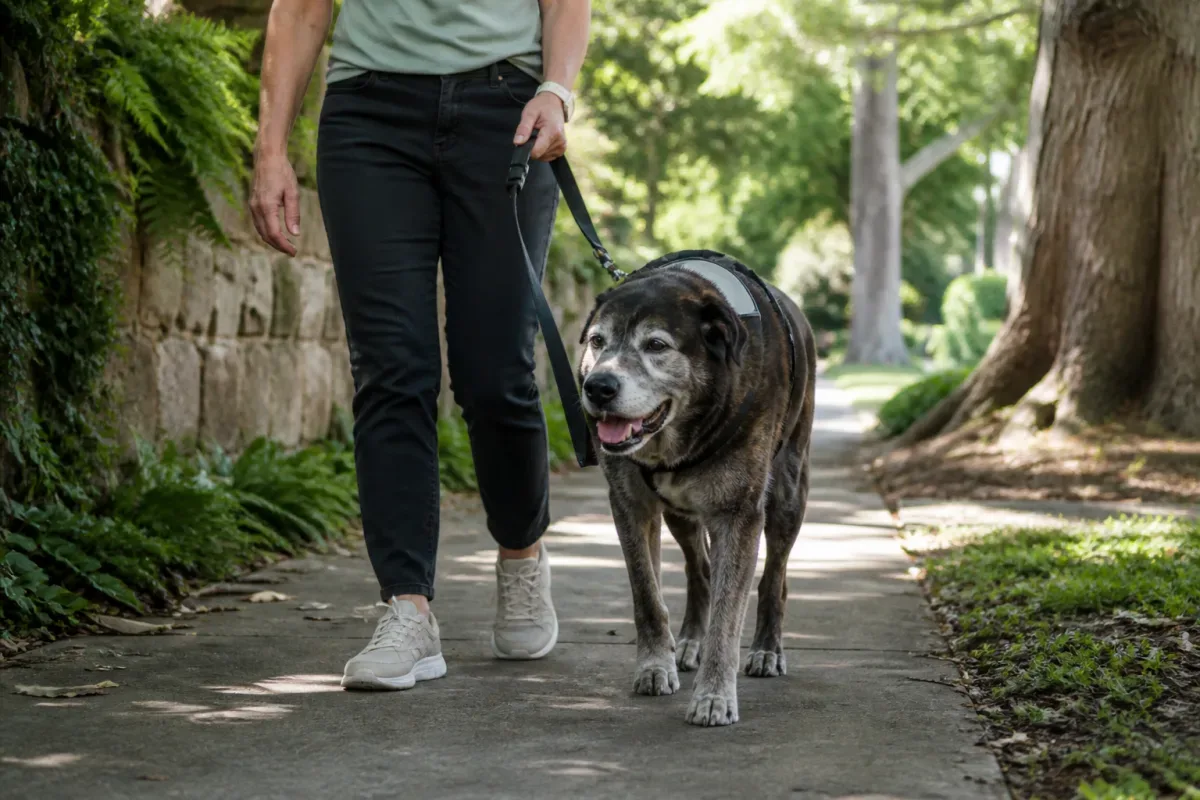
A senior dog mobility routine should make everyday movement more predictable, not turn exercise into a test. Older dogs can have different abilities from one day to the next, and a large dog may need more time to rise, turn, or settle after a walk. A useful routine starts with today’s baseline, uses low-impact movement in short blocks, improves footing and access at home, and leaves room to stop early.
This is general education, not a treatment plan. Speak with your veterinarian about new limping, pain, weakness, breathing changes, repeated falls, or a sudden decline. Ask for individualized exercise and rehabilitation guidance before adding stairs, swimming, range-of-motion work, or any equipment to a dog with a diagnosed condition.
Build a senior dog mobility routine around today’s baseline
Start by observing a normal morning rather than choosing a distance target. Note how your dog rises, walks across the room, turns on different surfaces, enters the vehicle, and settles after a short outing. The American Animal Hospital Association recommends more frequent wellness exams for senior pets and says low-impact activity should be adjusted to physical condition, mobility, and health.
Write a short baseline in plain language: “walks comfortably for ten minutes on level ground, rests easily, hesitates on slick tile.” That sentence is more useful than a generic promise to exercise more. Repeat the observation once or twice a week so you can discuss a pattern with your veterinary team.
Use the Fit Guide when you are assessing vehicle entry, body measurements, or mobility support. The goal is to make the dog’s current movement easier to understand and safer to support.
Check the starting signals before each session
Before a walk or home activity, look for readiness. Is the dog willing to stand? Can the dog place weight evenly? Are the first steps similar to yesterday, or is there a new reluctance? Observe the face, posture, pace, and willingness to turn. Do not force movement to complete a plan.
Use a stoplight for everyday decisions
- Green: the dog starts willingly, moves with a familiar rhythm, and settles after a short session.
- Yellow: the dog is slower, needs more pauses, or is less steady on a surface. Shorten the activity and record what changed.
- Red: the dog cries, collapses, cannot bear weight, has severe breathing trouble, or shows a sudden serious change. Stop and seek veterinary help.
This stoplight is a communication aid, not a diagnosis. A dog can hide discomfort, and a calm appearance does not rule out a medical problem.
Use low-impact movement in short blocks
The American College of Veterinary Surgeons describes controlled leash walks and consistent low-impact activity as alternatives to high-impact running or jumping for dogs with osteoarthritis, while noting that rehabilitation choices should be individualized. For a general senior dog mobility routine, think in small repeatable blocks: a gentle start, a short movement period, a quiet pause, and a calm finish.
Choose stable, predictable surfaces. A slow sniffing walk may provide physical and mental value without requiring speed. Indoors, a few deliberate passes between comfortable resting points can be enough on a difficult-weather day. Avoid adding hills, stairs, fetch, or jumping just because the dog seems enthusiastic at the beginning. The next-day response matters too.
Change one variable at a time
If the current routine is comfortable, change only one element: a few extra minutes, a slightly different surface, or a second short block later in the day. Hold that change long enough to observe recovery before adding another. This makes it easier to tell whether the dog is responding well or simply compensating until later.
Keep the first few weeks deliberately boring. Use the same doorway, the same quiet stretch of pavement, and the same comfortable harness while you learn the dog’s pattern. A familiar sequence makes small changes easier to notice and gives the dog time to move without rushing. If a session ends well, write down what made it easy: cooler weather, a dry surface, a later start, or a longer pause. Those details can be more useful than a distance total when you plan tomorrow. The routine should make observation simpler for the family and communication clearer for the veterinary team.
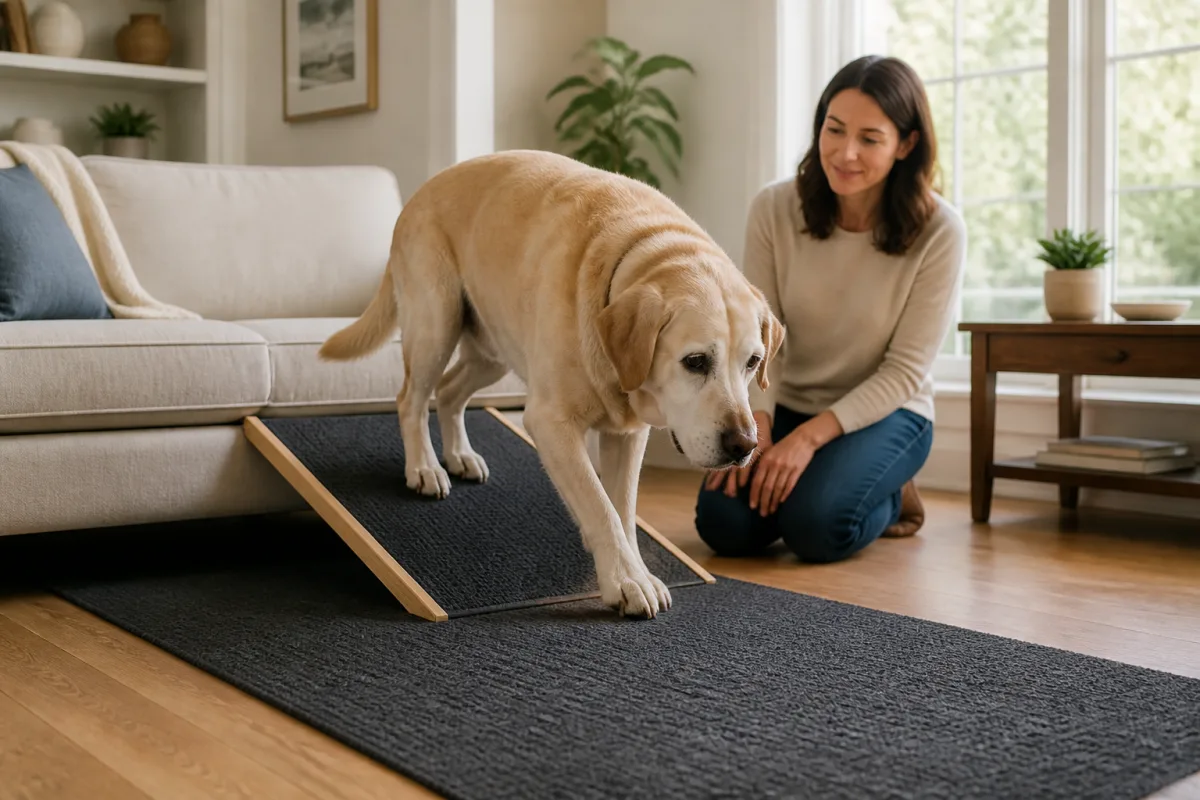
Add traction, ramps, and rest to the routine
Movement is affected by the environment. AAHA recommends practical modifications such as ramps, nonslip surfaces, orthopedic bedding, and suitable harnesses or slings for mobility-compromised pets. Place traction where the dog starts, turns, eats, drinks, and reaches the door. A few well-positioned runners can be more useful than covering the entire house.
Test a ramp when everyone is calm. Give the dog time to look at it, place a foot on it, and back away without pressure. Keep the ramp stable and use the support system recommended for your dog. A ramp is an access tool, not a reason to move the dog faster than they can control.
For outings that are meaningful but longer than the dog can comfortably walk, a stroller can preserve participation while reducing the walking demand. Read the large dog stroller fit guide when you are comparing access, trunk space, and support needs. Keep the dog’s ability to stand, reposition, and rest at the center of the decision.
Track your senior dog mobility routine without chasing a number
Use a simple note with four fields: activity, surface, duration, and recovery. Add one sentence about appetite, sleep, or willingness to move later if something is different. This creates a useful record for your veterinarian and helps you notice patterns that a single good walk can hide.
Do not compare your dog’s routine with another dog’s routine. Breed, body condition, previous injuries, joint health, temperature, and household flooring all change what “easy” means. The most useful goal is a repeatable day that leaves the dog comfortable enough to participate again.
Know when the routine needs a veterinary review
Book a review when a yellow signal repeats, the dog needs substantially longer to recover, or a familiar activity becomes difficult. AAHA notes that early treatment can help manage pain and preserve mobility, and ACVS explains that osteoarthritis management may combine weight control, activity modification, rehabilitation, pain control, and other veterinary decisions.
Bring your notes and short videos of the dog moving on the usual surfaces. Ask what activity is appropriate, which signs mean stop, whether a rehabilitation referral is suitable, and how the home environment can be adjusted. Do not start or change prescription medication, supplements, or therapy based only on an online checklist.
Use a weekly senior dog mobility routine
A weekly structure can reduce decision fatigue while keeping the dog’s response in charge:
- Two or three short walks: choose stable footing and stop before the dog looks tired.
- Daily access checks: inspect traction, ramps, bed placement, water access, and vehicle entry.
- Quiet enrichment: use scent games, food puzzles, or gentle interaction that does not require jumping.
- One review day: compare notes, check recovery, and decide whether the next week should stay the same or be discussed with a veterinarian.
Keep the senior dog mobility routine visible to everyone who helps with care, so the same calm stop signals and recovery notes guide each day.
The exact schedule should follow your dog’s health plan. Consistency does not mean doing the same amount every day; it means using the same calm process to decide what is appropriate today.
Review the senior dog mobility routine after a full day, not only after the walk itself, so recovery and sleep inform the next plan.
Make outings easier with a senior dog mobility routine
Mobility support works best when it protects choice. Let the dog pause, turn around, or return home. Keep water available, choose shaded or climate-appropriate times, and make the car entry stable. A support product can help with access, but it cannot confirm that a dog is pain-free or ready for more activity.
When walks get shorter, the outing can still include the same smells, people, and quiet pauses. A stroller, a nearby bench, or a short route can keep the dog connected to family life without asking for a performance. The goal is a dignified rhythm that can be repeated.
Use a reset week after a difficult day
One unusually long outing, a hot day, a slippery floor, or a poor night of sleep can change the next morning. Instead of trying to “make up” the activity, use a reset week. Return to the last routine that felt comfortable, keep the route familiar, and add extra rest between short blocks. Record whether the dog rises, turns, and settles more easily over the next several days.
A reset is also a useful time to inspect the environment. Move bowls closer, clear a narrow hallway, secure loose rugs, and check that a ramp cannot slide. Ask another family member to watch the dog move from a different angle; small changes in posture or footing are easier to notice when one person is not also holding the leash. If the dog does not return to the usual baseline, share the notes and videos with your veterinarian.
Official veterinary resources
Review AAHA’s senior pet guidance for low-impact activity, environmental changes, and regular veterinary care. AAHA’s veterinary care recommendations describe joint and mobility support, rehabilitation, and pain conversations. The American College of Veterinary Surgeons overview of canine osteoarthritis explains activity modification and rehabilitation in a clinical context.
Frequently asked questions
How often should a senior dog mobility routine be used?
Use a calm, repeatable process daily, but adjust the amount to the dog’s current condition. Short, consistent low-impact sessions are usually easier to evaluate than occasional demanding outings.
Is a short walk enough for an older dog?
It can be a useful part of the day when the surface, pace, and recovery fit the dog. Add mental enrichment and comfortable rest rather than extending the walk automatically.
Should I use a ramp or harness for a large senior dog?
A ramp or properly fitted support may improve access, but introduce it gradually and ask your veterinary team which design and technique fit your dog.
When should I stop a mobility session?
Stop for a sudden change, pain signal, severe weakness, repeated loss of balance, breathing trouble, or inability to recover normally. Contact a veterinarian for concerning or persistent changes.