

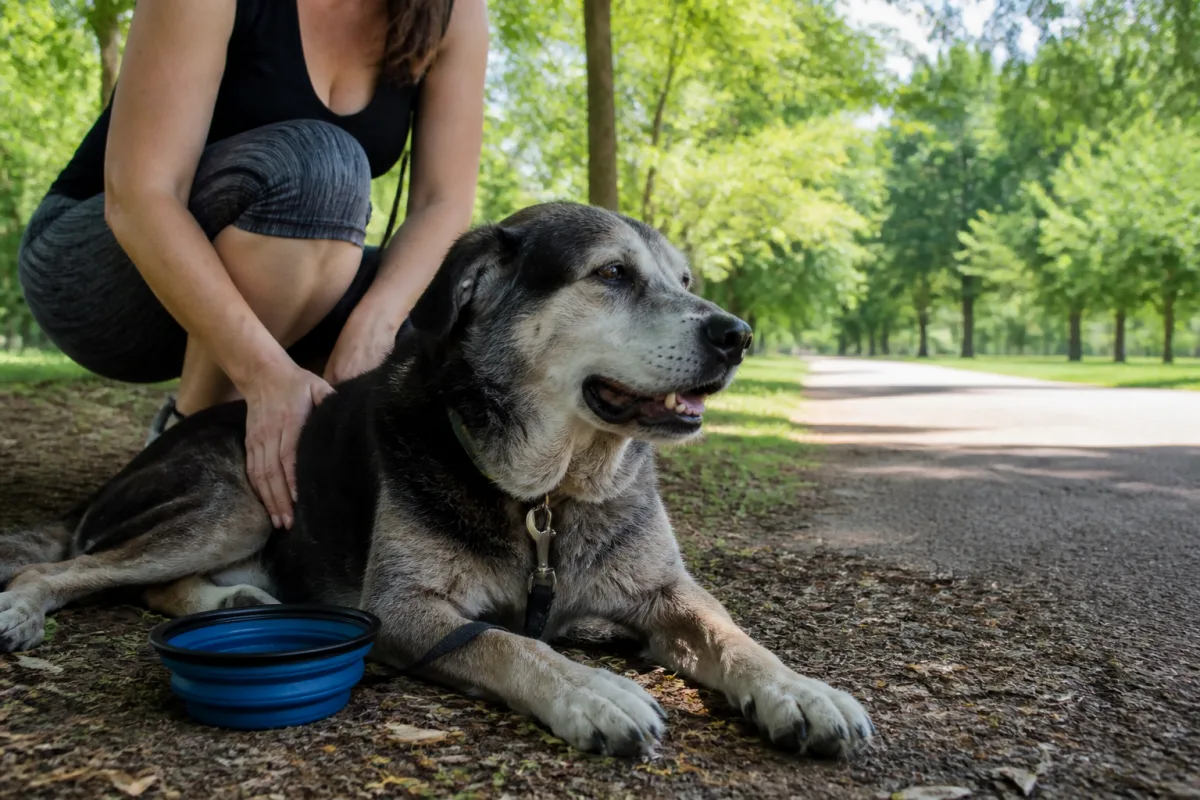
Senior dog heat safety begins with a smaller promise than “we will finish the walk.” The useful promise is that your dog can join a calm outing and return home before warmth changes breathing, balance, attention, or comfort. Older dogs do not all respond to summer conditions in the same way. Health, coat, body condition, humidity, sun, pavement, acclimation, and medication can change the margin on any particular day. That makes a flexible plan more valuable than a fixed distance target.
This guide offers general preparation and first-aid boundaries, not an individual medical assessment. Ask your veterinarian how age and current health affect your dog’s heat risk. If a dog shows signs of heat illness, stop the activity and contact a veterinary professional promptly.
Senior dog heat safety starts before the door opens
Check the full outing, not only the temperature shown on a phone. Direct sun can turn an otherwise familiar path into a hotter route. Humidity can make cooling harder. Dark pavement and exposed parking areas may add heat at the beginning and end of the trip. A dog who has spent most of the season indoors may also need a more gradual return to warm-weather activity than a dog who has already acclimated.
Official heat alerts add another useful signal. A National Weather Service Heat Advisory, Watch, or Warning describes risk to people, not a dog-specific medical cutoff. Still, treating an alert as a reason to shorten, reschedule, or cancel a dog outing is a sensible planning inference. It keeps the decision anchored to current local conditions instead of habit.
Avoid searching for one universal “safe temperature.” Cornell veterinary guidance notes that elderly dogs and dogs with obesity, heavy coats, heart disease, or breathing conditions may face greater heatstroke risk. Your veterinarian can help turn those general risk factors into a plan for the dog in front of you.
Build a senior dog heat safety route with a clear exit
A summer outing should be easy to stop. Choose a cooler time of day, a route with dependable shade, and a turnaround point that comes before the most exposed section. Park where the return to the vehicle or home is short. If a quiet shaded bench, covered pavilion, or tree line disappears halfway through the route, that is not a reliable rest plan.
Bring drinking water, a clean bowl, a leash, waste bags, a light towel, and the phone number for your regular and nearest emergency veterinarian. Offer water during calm pauses rather than waiting for obvious distress. Never leave a dog in a parked vehicle, even for a quick errand. A closed vehicle can become dangerous rapidly, and cracking a window does not make it safe.
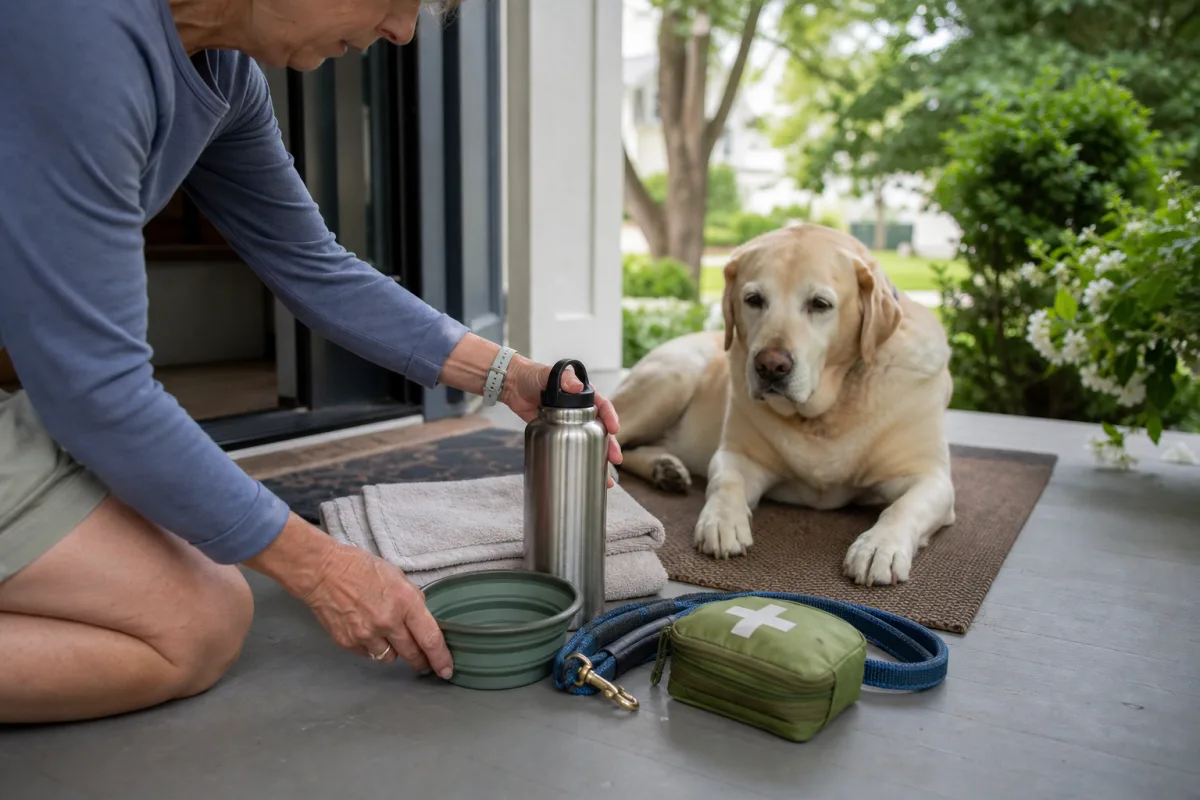
Before leaving, make three decisions in plain language:
- Turnaround point: the place where you will head back even if the dog still seems willing.
- Early stop signal: a change in panting, pace, shade-seeking, gait, or attention that ends the outing immediately.
- Escalation plan: where you will cool the dog and which veterinary clinic you will call if recovery is not prompt and complete.
This structure makes senior dog heat safety a decision made in advance, not a debate after everyone is already far from the exit.
Read canine heat stress warning signs before distance
Dogs cool themselves mainly through panting, so panting by itself does not tell the whole story. Watch for a rapid increase beyond your dog’s normal response, especially when it arrives with slowing, repeated shade-seeking, heavy drooling, reluctance to continue, a change in gait, reduced attention, or difficulty settling. Cornell and University of Illinois veterinary guidance both emphasize recognizing changes before they progress to a heat emergency.
Compare the dog with their own baseline
A gray muzzle is not a diagnosis, and age does not produce one predictable walking pattern. Notice what is different today. Is the dog lagging where they usually move freely? Are they standing with a wider or less stable posture? Are they ignoring familiar cues or water? Does panting stay intense after activity stops? The change from the dog’s normal pattern matters more than the number of minutes on the trail.
When an early signal appears, move to shade, stop exertion, offer water without forcing it, and begin the exit. Do not add “just one more loop.” A short, uneventful return home is the successful outcome. Senior dog heat safety should preserve the next outing rather than squeeze the maximum distance from this one.
Know the line between a warm dog and an emergency
Heat illness can progress beyond heavy panting to weakness, vomiting or diarrhea, disorientation, collapse, seizures, or loss of consciousness. Those are emergency signs. Call a veterinarian or emergency hospital immediately while beginning active cooling and arranging transport. Do not wait to see whether a severely affected dog “walks it off.”
The American Veterinary Medical Association’s first-aid guidance advises moving the animal to a shaded, cool area; applying room-temperature water; using airflow from a fan when available; and transporting the dog to a veterinary hospital. It cautions against immersing the animal in cold water. The goal is prompt, controlled cooling with professional care, not an extreme temperature shock.
Even if a dog appears better after cooling, veterinary guidance still matters because dangerous complications may not be visible at the trailhead. The calmest response is also the most direct: stop, cool, call, and transport as instructed.
Use senior dog heat safety as an exit rule, never a heat shield
A large dog may be too heavy to carry comfortably when an outing needs to end. Practicing a supported exit before summer can reduce improvisation. Record current measurements, entry needs, handler reach, and vehicle space in the Steadavo Fit Guide. Rehearse loading and unloading at home while conditions are comfortable.
Mobility support does not make unsafe weather safe. It does not replace shade, hydration, veterinary advice, or an appropriate route. A stroller or other support can also retain warmth if airflow is poor or the product sits in direct sun. Keep any supported rest in shade, maintain ventilation, and keep watching the dog rather than assuming that stopping the walk has ended the heat risk.
For a broader routine about choosing a shorter day without losing the family outing, read When Walks Get Shorter. Keep the roles separate: that article is about inclusion and pacing; this one is about senior dog heat safety and the decision to avoid or end heat exposure.
Make the senior dog heat safety plan repeatable
A useful checklist fits on one screen and changes with the forecast. Review it before each warm-weather outing rather than treating it as a one-time summer setup.
Before leaving
- Check the local forecast, humidity, sun exposure, and any official heat alert.
- Choose the cooler, shorter version of the route and identify continuous shade.
- Confirm water, bowl, towel, leash, waste bags, phone, and veterinary contacts.
- Consider recent illness, medication changes, missed sleep, appetite, and the dog’s current baseline.
- Cancel when the route or conditions remove the margin your dog needs.
During the outing
- Start slower than the dog’s normal cool-weather pace.
- Pause in shade before panting or fatigue becomes pronounced.
- Offer water and check gait, attention, drooling, and willingness to continue.
- Turn back at the planned point even when the outing feels easy.
- End immediately at the first meaningful change from baseline.
After returning
- Settle the dog in a cool, ventilated space with water available.
- Keep watching breathing, coordination, energy, and gastrointestinal signs.
- Contact a veterinarian promptly if recovery is slow, incomplete, or concerning.
- Record what worked so the next outing begins with better limits.
Avoid the shortcuts that erase the safety margin
Cooling vests, mats, fans, and water gear may be useful parts of a plan, but no accessory creates permission to stay out longer in dangerous heat. Do not use a product as evidence that conditions are acceptable. The route, weather, individual dog, and exit distance still control the decision.
Likewise, a dog who eagerly approaches the door has not completed a medical risk assessment. Excitement can carry an older dog past an early limit. A calm handler protects the dog by ending the outing while the dog still looks capable, not after the dog proves that the plan was too ambitious.
Do not let a familiar route create false confidence. Shade shifts through the day, a water fountain may be out of service, and a quiet path can become exposed when the return takes longer than expected. Carry your own water, keep the turnaround conservative, and notice whether the dog recovered fully after the last warm outing. A plan that worked last week is evidence to consider, not permission to repeat the same distance today.
The best senior dog heat safety routine is deliberately ordinary: check, shorten, shade, observe, and leave early. That restraint keeps summer participation centered on present comfort rather than a mileage target.
Sources and veterinary boundaries
This article draws on Cornell University College of Veterinary Medicine heat-safety guidance, the University of Illinois College of Veterinary Medicine discussion of heat-related illness, National Weather Service heat-alert definitions, and the AVMA Pet First Aid guide. Weather alerts are used here as a conservative outing-planning trigger; they are not dog-specific medical thresholds.
Continue with the Senior Dog Care field notes for related general education. For symptoms, medication questions, disease-specific risk, or any suspected heat illness, speak with a veterinarian who can assess the individual dog.
Frequently asked questions
Is there one safe outdoor temperature for every senior dog?
No. Age, health, coat, humidity, sun, surface temperature, acclimation, and activity all change risk. Use current conditions and your veterinarian’s individual guidance rather than relying on one universal cutoff.
What are early signs that an older dog is getting too hot?
Heavy or rapidly increasing panting, slowing down, seeking shade, drooling, reluctance to continue, or a change from the dog’s normal gait or attention can be early reasons to stop and cool down.
Should I use ice water on a dog that may be overheating?
Authoritative veterinary first-aid guidance advises starting active cooling with room-temperature water and airflow while arranging prompt veterinary care, rather than immersing the dog in very cold water.
Can a mobility product make a hot outing safe?
No. Mobility support can help a family end a suitable outing early, but it does not remove heat risk, replace shade and water, or make dangerous conditions acceptable.