

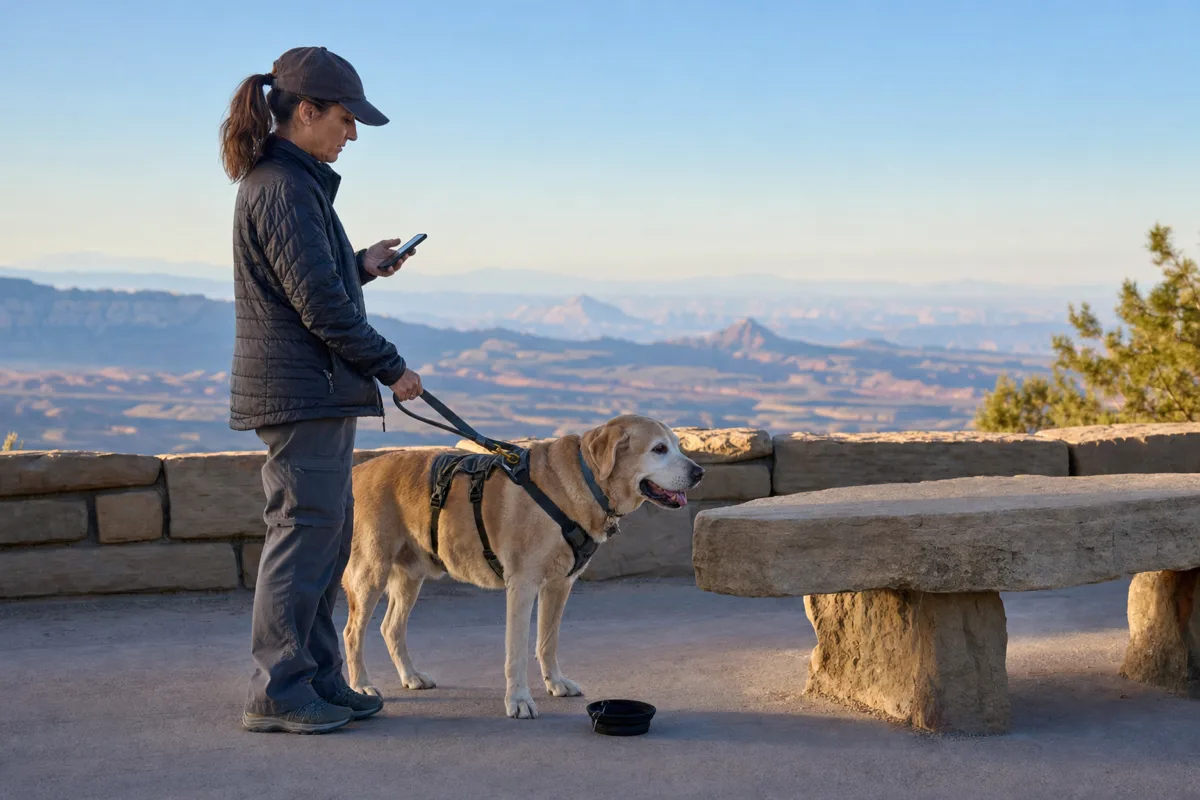
National park dog rules are not one nationwide list that can be memorized once. The National Park Service manages hundreds of places with different landscapes, wildlife concerns, historic resources, roads, campgrounds, and local regulations. A dog may be welcome on a paved path or campground loop at one site and restricted from a nearby trail at another. The dependable approach is to verify the specific park, the specific area, and the current day before leaving home.
Verify National Park Dog Rules on the Official Park Page
Begin at the National Park Service’s national pets page, then follow the link to the park you plan to visit. Do not rely on a social post, an old travel article, or a map pin that simply says “dog friendly.” Those sources may describe one section of a park, a rule that has changed, or an experience from a different season.
On the park’s official site, look for pages labeled Pets, Plan Your Visit, Conditions, Alerts, Campgrounds, and Hiking. If the answer is still unclear, use the park’s published contact information. Save the official page on the phone, but also write down the essential rule because reception can be limited at entrances and trailheads. This turns national park dog rules into a verifiable trip note instead of a memory or assumption.
A useful first check answers five questions:
- Which roads, paths, trails, buildings, beaches, and campgrounds allow pets?
- What leash or physical-control rule applies in those areas?
- Are there seasonal closures or temporary wildlife restrictions?
- Can a pet be left unattended in a campsite or vehicle?
- Where are the nearest permitted relief and turnaround points?
Read Park Pet Rules at the Area Level
“Pets are allowed in the park” does not mean pets are allowed everywhere in the park. A park can include public roads, parking areas, developed campgrounds, paved overlooks, backcountry routes, beaches, buildings, and protected habitat under different rules. Check the named destination rather than stopping at a general welcome statement.
Trail descriptions need the same attention. If the official page lists only certain pet-friendly trails, assume unlisted trails are not approved until the park confirms otherwise. If a route crosses land managed by another agency, verify both jurisdictions. A trailhead outside a park boundary does not guarantee that the full route follows the same rule.
Copy the exact permitted area into the trip note. “Paved loop from the visitor parking area” is more useful than “dogs allowed.” That level of detail prevents an argument with memory after a long drive.
Summarize Dog Access Rules in a One-Minute Card
A short rule card keeps the official information usable. Put it in the same trip note as the address and parking plan. It should fit on one screen and contain only current, destination-specific details:
- Allowed area: the named path, road, campground, or developed zone.
- Control rule: the park’s stated leash length and handling requirement.
- Current alert: closure, fire restriction, construction, wildlife activity, weather, or access change.
- Waste plan: bag supply and the nearest confirmed disposal point.
- Plan B: a permitted shorter stop if the intended route is closed or unsuitable.
Add the date checked and the official URL. Put national park dog rules in the card only after matching them to the named destination, permitted area, and date checked. Conditions can change after a note is saved, so recheck it on the morning of departure.
Match Park Pet Rules to a Suitable Outing
Permission answers only whether a pet may enter. It does not answer whether the route is a good choice for the dog in front of you. Surface temperature, shade, elevation, footing, crowds, distance to water, noise, and the return route all matter, especially for a large or senior dog.
Review the official conditions page and the hourly weather before leaving. Then compare the route with the dog’s current pace and comfort on familiar ground. A pet-friendly path can still be too exposed, too busy, or too far from the vehicle for that day. Turning back early is a completed outing, not a failed one.
Build the plan around the return, not just the destination. Know where the dog can rest without blocking other visitors, how far the vehicle is from the farthest point, and what happens if the pace slows. The related Field Note When Walks Get Shorter offers a calm framework for keeping a family routine open with a shorter active section and a planned rest option.
Use B.A.R.K. as the behavioral baseline
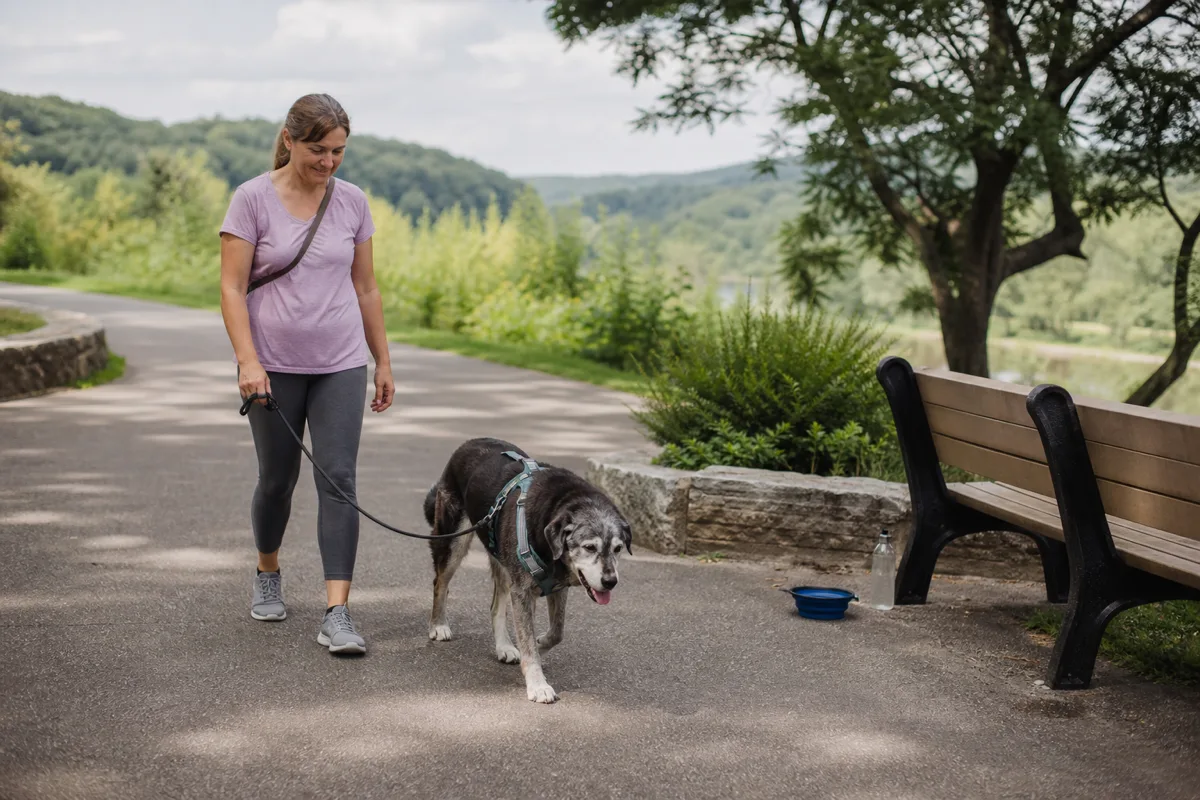
The National Park Service’s B.A.R.K. Ranger guidance provides a simple national baseline: bag the dog’s waste, always leash the pet, respect wildlife, and know where pets can go. A participating park may add local details, but these four habits are useful before reaching any trailhead.
Bag waste and carry it out correctly
Bring more bags than the expected number of stops and know whether bins are available. Do not leave a filled bag beside a trail for later pickup. The bag is still waste, and wildlife, weather, or another visitor can move it before you return.
Always use the required leash
A leash protects more than recall. It creates a predictable distance from wildlife, cliff edges, traffic, bicycles, children, other dogs, and fragile areas. Use the length and physical-control method stated by the park. A retractable setup may not satisfy a local rule or provide useful control in a crowded space.
Respect wildlife at a generous distance
A calm dog can still change an animal’s behavior, and a quiet animal can move suddenly. Never use wildlife as a close-photo opportunity. Keep moving or turn around when an animal occupies the route, and follow ranger directions. Feeding or allowing a dog to pursue wildlife is not part of a responsible visit.
Know where pets can go
Check before the dog leaves the vehicle, then read signs at the entrance and trailhead. A temporary notice on site is newer than a screenshot saved days earlier. When the two differ, follow the current posted direction and ask park staff for the permitted alternative.
Give a large or senior dog more margin
Large dogs need room to turn, settle, and pass other visitors without crowding the route. Senior dogs may need more time on transitions, uneven surfaces, or busy parking areas. Add margin by choosing an off-peak arrival, parking near a permitted route, and selecting a short loop with an obvious exit.
Carry water for the dog even when a map shows a stream. Natural water can be inaccessible, seasonally dry, fast moving, or unsuitable. Bring a familiar bowl, waste bags, a towel, and a compact rest layer if the permitted area has an appropriate place to use it. Keep food secured and follow local storage rules in wildlife country.
Shade moves during the day. A route that looks comfortable in an early photograph may be exposed by midday. Check timing, surface, and parking together. If the vehicle will be the main rest point, never treat it as a waiting room in unsafe temperatures.
After confirming the national park dog rules, check that any mobility support fits the current dog, handler, vehicle, and permitted surface before travel. The Fit Guide can help organize measurements and handling questions. Mobility equipment does not override a park’s pet restrictions, and a wheeled device may be impractical on steps, narrow paths, deep gravel, or crowded overlooks even where pets are allowed.
Keep Pet Rules Separate from Service-Animal Guidance
National park pages may publish separate information for pets and service animals. Do not assume the pet page fully describes service-animal access, and do not describe a pet as a service animal to enter a restricted area. Travelers who need service-animal information should use the park’s official accessibility guidance and contact the park for current, destination-specific details.
This distinction also matters when sharing advice. A statement such as “dogs are not allowed on this trail” may be accurate for pets while leaving out separate service-animal provisions. Link the official source instead of compressing different rules into a social caption.
Create a compliant Plan B
The best dog-friendly park plan includes an alternative outside the restricted area. Look for a permitted developed path, scenic drive stop, campground loop, gateway-community trail, or nearby public land whose own agency rules have been checked. Do not assume land outside the entrance follows National Park Service policy.
A Plan B should be satisfying on its own. Choose a clear distance, a quiet stopping place, and a return point that suits the dog. If the main route closes, the family can change plans without debating rules in the parking lot or leaving the dog in the vehicle.
Run the final check on arrival day
Before departure, open the official park page rather than relying only on the saved rule card. Recheck national park dog rules alongside alerts, conditions, weather, road access, and the pet page. At the park, read entrance and trailhead notices before unloading.
- Confirm the exact permitted area is still open.
- Set the leash and waste supplies before opening the vehicle door.
- Check the dog’s pace and the surface near the parking area.
- Identify the turnaround point and nearest appropriate rest location.
- Leave early if conditions, crowds, wildlife, or the dog’s comfort differ from the plan.
National park dog rules work best as a repeatable verification routine: official page, current alert, named permitted area, practical route, and a compliant alternative. That approach stays useful even when the destination changes.
Official National Park Service resources
- National Park Service pets portal
- NPS guidance for visiting parks with pets
- NPS hiking with pets checklist
- NPS B.A.R.K. Ranger principles
Frequently asked questions
Are dogs allowed in every U.S. national park?
Pet access varies by park and often by area within the same park. Check the official National Park Service page for the exact destination, then review current alerts and posted signs on arrival.
Does pet-friendly mean dogs can use every trail?
No. A park may allow pets in developed areas, campgrounds, roads, or selected trails while restricting other routes. Record the named permitted area rather than relying on a general pet-friendly label.
What are the B.A.R.K. Ranger principles?
The National Park Service summarizes them as bag your pet’s waste, always leash your pet, respect wildlife, and know where you can go. Individual parks may publish additional local requirements.
Does a dog stroller change national park pet restrictions?
No. Mobility equipment does not override a park’s pet rules. Confirm both pet access and whether the permitted surface is practical for the dog, handler, and equipment.